
- Home
- How to Build a Brand That Customers Remember
How to Build a Brand That Customers Remember
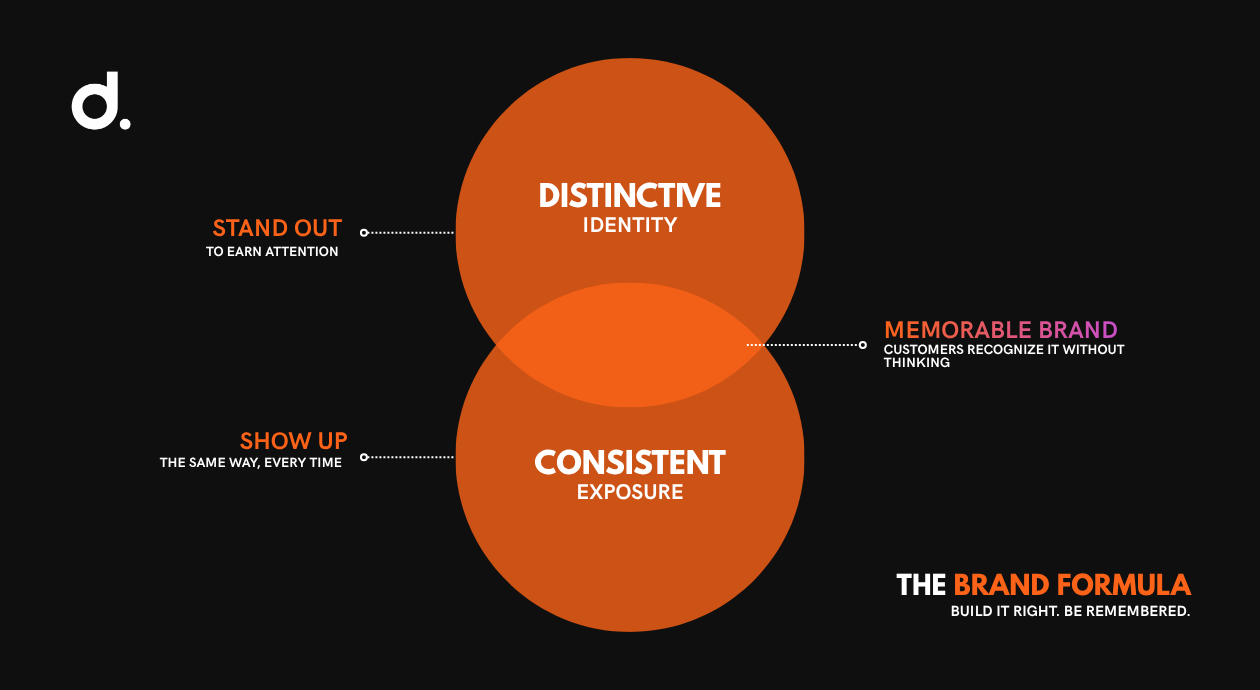
Learning how to build a brand is not about finding the cleverest logo or choosing a fashionable colour palette. A memorable brand has clear positioning, a distinctive identity, and enough consistent exposure for customers to recognize it without having to work at it.
That is not marketing folklore. It is how memory works.
People are more likely to recognize things they encounter repeatedly. They are also more likely to remember something that stands apart from the information surrounding it.
A strong brand does both.
It looks and sounds different enough to earn attention, then repeats the same recognizable signals long enough for them to stick.
What Actually Makes a Brand Memorable?
A memorable brand balances two forces:
Familiarity: People encounter the same identity, message, and promise often enough to recognize it.
Distinctiveness: Those elements are different enough from competing brands that people do not confuse them.
Repetition without distinctiveness makes a brand familiar but interchangeable.
Distinctiveness without consistency creates an interesting first impression that people quickly forget.
Brand recognition grows when both work together.
The Mere-Exposure Effect: Why Repetition Builds Recognition
The mere-exposure effect describes the tendency for repeated exposure to an initially neutral stimulus to increase familiarity and, under many conditions, liking.
Psychologist Robert Zajonc formally explored the effect in his influential 1968 paper, “Attitudinal Effects of Mere Exposure.” His research argued that repeated exposure alone can improve a person’s attitude toward a stimulus, even without new information being added.
Later research has continued to find that repeated exposure can increase familiarity, recognition, and positive preference, although the size and conditions of the effect vary.
For a business, this means consistency has a psychological purpose.
When a customer repeatedly sees the same:
- Brand name
- Logo
- Colour palette
- Visual style
- Tone of voice
- Positioning message
- Product promise
those elements become easier to process.
The customer no longer has to work out who is speaking or what the business represents every time it appears.
Recognition begins to form.
This does not mean posting the exact same advertisement repeatedly until people become irritated. It means presenting the same core identity through different useful touchpoints.
A customer might first encounter your brand through a LinkedIn post, then visit your website, read a guide, receive an email, see a retargeting ad, and eventually hear your name from a colleague.
The content changes.
The brand should not.
The Distinctiveness Effect: Why Different Beats “Better”
The distinctiveness effect, often called the Von Restorff or isolation effect, describes how an item that stands apart from similar surrounding items is more likely to be remembered.
If one word in a list appears in a different colour, size, or category, people tend to recall it more easily than the words that blend together.
The effect was first studied systematically by Hedwig von Restorff in 1933 and has been supported by later memory research. Studies continue to find stronger recall for physically or semantically distinctive items.
Branding works in a similar context.
Your customer rarely evaluates your identity in isolation. They see it beside competitor websites, ads, social profiles, packaging, proposals, and marketplace listings.
If every company in the category uses:
- The same muted blue
- The same geometric symbol
- The same stock photography
- The same “innovative solutions” language
- The same claims about quality and service
even a polished brand may become difficult to remember.
The problem is not that it looks bad.
It looks like everything else.
Distinctiveness does not require being loud, strange, or deliberately controversial. It requires making choices that belong recognizably to your business.
A professional-services company could stand apart through a highly specific positioning statement rather than unusual design.
A consumer brand may use an unexpected colour, illustration style, package shape, or tone.
A local business might become known for one named process, promise, or customer experience that competitors do not offer.
The goal is not to be different in every possible way. It is to own a few meaningful differences consistently.
Do Customers Really Need Five to Seven Impressions?
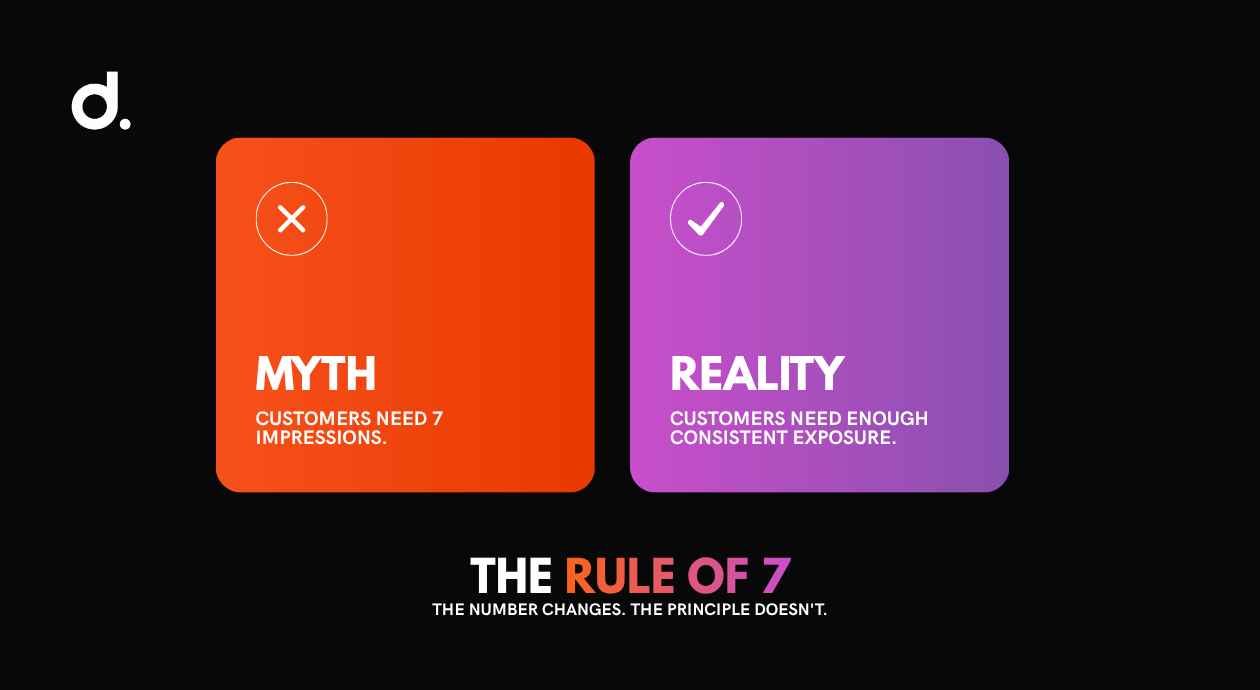
You have probably seen the claim that a customer needs to encounter a brand five to seven times before remembering it.
Treat that number carefully.
The closely related “Rule of Seven” is generally described as an advertising rule of thumb or heuristic, not a precise scientific law. It suggests that repeated messaging is necessary, but it does not prove that seven exposures will produce recognition or a purchase in every market.
A customer choosing a chocolate bar may need very little exposure.
A committee purchasing a complex B2B platform may interact with the brand many times over several months.
The exact number changes according to:
- Purchase risk
- Product complexity
- Existing awareness
- Market competition
- Message quality
- Channel
- Customer need
- Time between interactions
The useful idea behind the rule is not the number seven.
It is that one good post, ad, email, or event is rarely enough to build lasting recognition.
How to Build a Brand Strategy Before Designing the Logo
A memorable visual identity needs something meaningful to express.
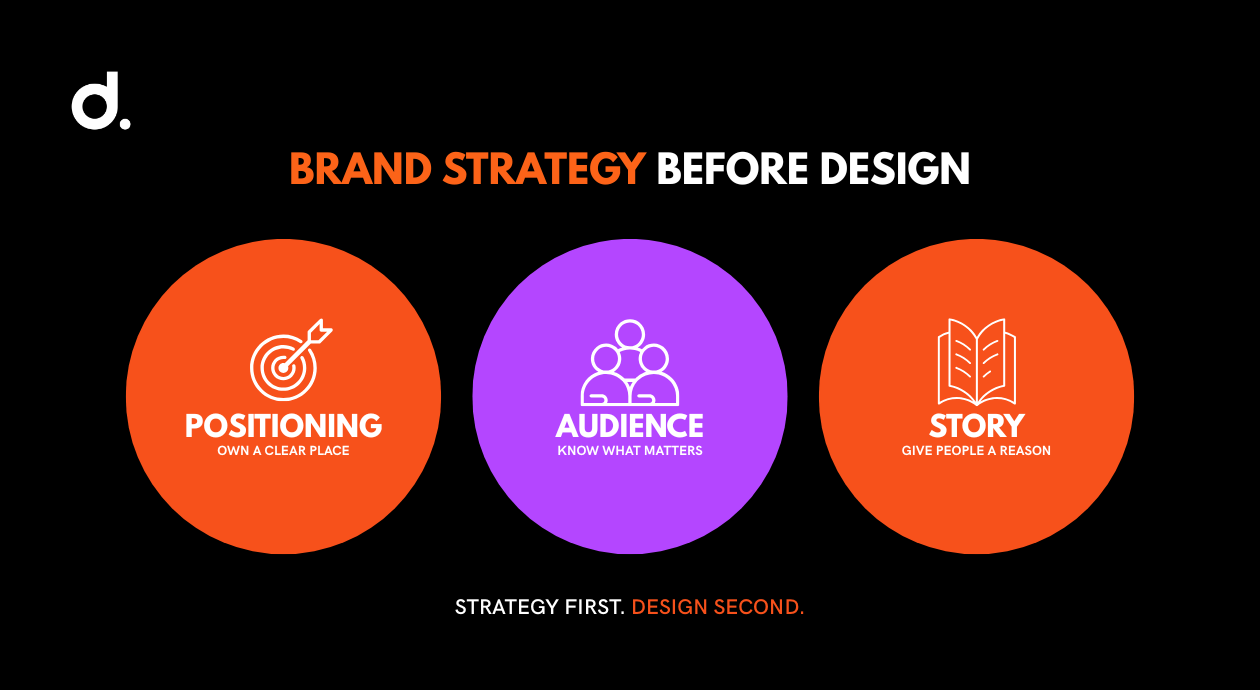
Before designing a logo, choosing fonts, or developing social templates, define what the brand is meant to stand for and why a particular customer should choose it.
Digital Shaping’s Brand Strategy and Identity work begins with positioning, voice, identity, and the wider system required to keep a brand recognizable across channels. Digital Shaping itself describes its branding approach as building brands people remember and trust through clear positioning, a consistent identity, and a message that sets the business apart.
Define Your Brand Positioning
Brand positioning is the specific place you want your business to occupy in the customer’s mind.
It answers three questions:
- Who is the brand for?
- What category or problem does it compete in?
- Why should that customer choose it instead of another option?
Weak positioning relies on statements almost any competitor could use:
We provide high-quality solutions and exceptional customer service.
Nothing in that sentence is easy to remember. It does not name a customer, problem, meaningful difference, or outcome.
A stronger version might be:
We help multi-location dental practices reduce missed calls and convert more enquiries through a managed patient-response system.
That sentence gives the customer something concrete.
It names the audience.
It defines the problem.
It explains the service.
For a local business, positioning may focus on specialisation, speed, location, service model, customer type, or experience.
For a product business, it may focus on ingredients, sourcing, design, use case, price level, community, or category innovation.
Do not try to become memorable by claiming ten advantages.
Choose the difference you are prepared to repeat and prove.
Know Your Audience Beyond Age and Income
Demographics help describe who someone is.
They do not fully explain why that person chooses one brand over another.
A useful audience profile should include:
- What the customer wants to achieve
- What is currently frustrating them
- What they fear getting wrong
- What alternatives they have tried
- What makes them trust a provider
- Which objections delay the decision
- What language they use for the problem
- What a successful outcome looks like to them
Consider two customers of the same age, location, and income.
One may choose a skincare brand because she wants clinical proof and ingredient transparency.
The other may care more about sensory experience, packaging, community, and how the brand fits into her identity.
Their demographic profiles may look similar.
Their decision drivers are not.
Good branding reflects what the customer values, not what the business hopes they value.
Build a Real Brand Story
A brand story explains how the business came to exist, why it matters, and what continues to guide it.
It is not a fictional founder’s journey created to fill an About page.
The strongest brand stories usually contain a real tension:
- Something the founder experienced
- A problem that existing companies ignored
- A community that was poorly served
- A product that was unnecessarily difficult to find
- An industry practice the founder wanted to change
- A belief that shaped a different way of working
Diaspora Co. gives a useful example.
Shopify’s reporting describes how founder Sana Javeri Kadri’s investigation into the spice trade led her to examine outdated supply chains, farmer compensation, and the quality of spices reaching customers. That history is not a decorative story placed around the product. It explains the company’s sourcing model, education, partnerships, and reason for existing.
Your story does not need to be dramatic.
It needs to be true and connected to how the business operates now.
A founder saying, “I started this because I have always been passionate about quality,” is difficult to believe or remember.
A founder explaining the specific experience that exposed a gap in the market gives people something they can retell.
Build a Visual and Verbal Brand Identity That Sticks
Brand identity is the recognizable system through which the strategy becomes visible and audible.
It includes:
- Logo
- Colours
- Typography
- Photography
- Illustrations
- Layout
- Icons
- Motion
- Tone of voice
- Vocabulary
- Taglines
- Messaging structure
Each element should support the same personality and positioning.
The goal is not to make every piece of content look identical.
The goal is to make every piece feel like it came from the same business.
Create a Logo People Can Recognize From Memory
A memorable logo is usually:
- Simple
- Distinctive
- Legible
- Scalable
- Relevant
- Adaptable
Try describing the logo without showing it.
Can someone explain its basic shape?
Could they distinguish it from competitors?
Would it still work as a small social icon?
Would it remain recognizable without the company name beside it?
Complexity can make a logo feel impressive during a presentation but difficult to use in real life.
A logo has to work on a website header, profile image, proposal, mobile screen, sign, invoice, advertisement, and possibly packaging.
It should not require ideal conditions to remain recognizable.
Simplicity does not mean generic.
A plain wordmark using the same typeface and colour as every competitor may be simple but not distinctive.
The best identity decisions balance ease of recognition with enough personality to stand apart.
Use Colour as a Recognition Shortcut
Colour can help people identify a brand before they have read its name.
It also contributes to brand personality.
Research published in the Journal of the Academy of Marketing Science found that colour characteristics can affect perceived brand personality, familiarity, likability, and purchase intent. The research does not support simplistic rules such as “blue always means trust” for every business. It shows that colour influences perception in context.
Choose colours by considering:
- Category conventions
- Competitor palettes
- Brand personality
- Contrast
- Accessibility
- Digital and print use
- Cultural context
- Product environment
Using the same colour as competitors is not automatically wrong.
It becomes a problem when the colour, typography, imagery, and message all follow the same category pattern.
Colour should work as part of a system, not as a standalone personality test.
Also be careful with the popular claim that colour increases brand recognition by a precise percentage. Versions of the “80%” statistic appear frequently in marketing content, but the brief’s research did not identify a reliable original study supporting that exact number.
Colour matters.
You do not need an unsupported percentage to prove it.
Define a Brand Voice People Can Recognize
Brand voice is how the company sounds consistently.
Imagine the brand as a person.
Would that person be:
- Direct or diplomatic?
- Warm or restrained?
- Playful or serious?
- Bold or reassuring?
- Technical or plain-spoken?
- Formal or conversational?
- Challenging or supportive?
Do not choose five appealing adjectives and stop there.
Define how those qualities change actual writing.
For example:
Direct might mean opening with the answer rather than a long introduction.
Warm might mean acknowledging the customer’s frustration without becoming overly casual.
Expert might mean explaining evidence and trade-offs rather than using complicated language.
Bold might mean expressing a clear opinion instead of repeating safe industry advice.
Also define what the brand does not sound like.
For example:
- We do not exaggerate results.
- We do not use unexplained jargon.
- We do not sound overly cheerful when discussing a serious customer problem.
- We do not copy trending slang that does not fit our audience.
- We do not write generic motivational posts.
A recognizable voice helps a customer know who is speaking before they reach the logo.
Brand Consistency Is the Multiplier
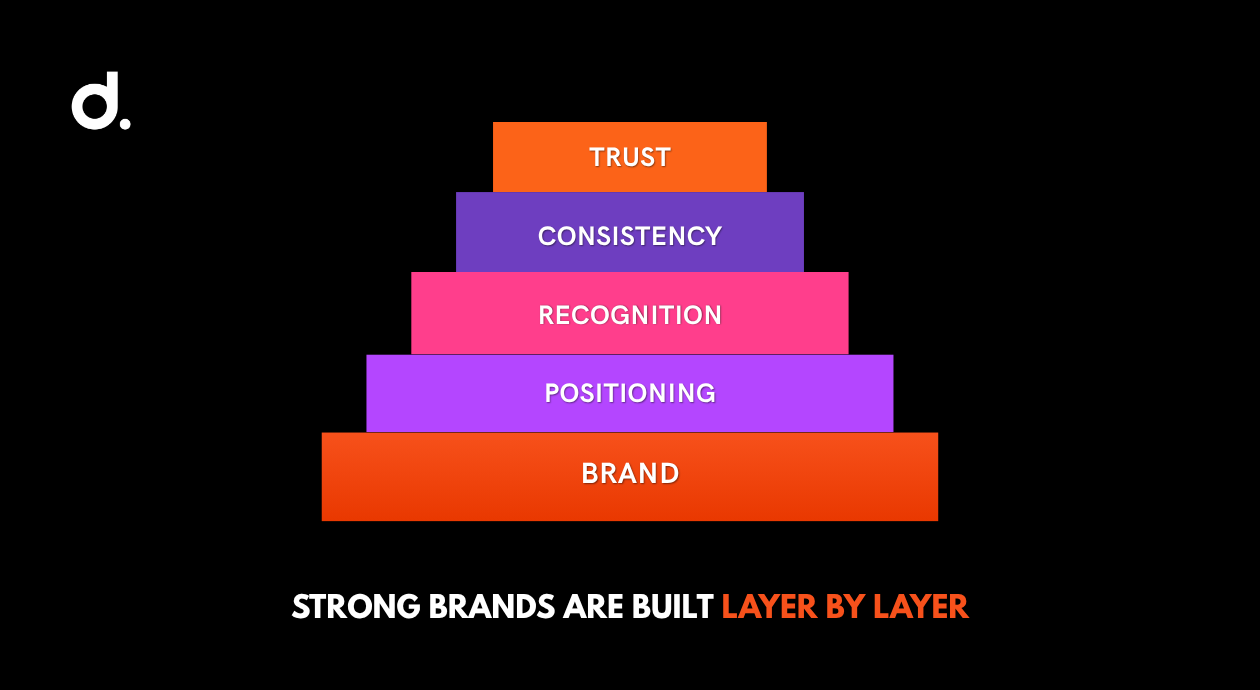
Brand consistency means presenting the same central identity, positioning, and promise across every meaningful customer touchpoint.
This includes:
- Website
- Social media
- Advertising
- Proposals
- Presentations
- Customer service
- Packaging
- Invoices
- Signage
- Sales calls
- Recruitment
- Product experience
Consistency strengthens the familiarity created through repeated exposure.
Inconsistency interrupts it.
Imagine a customer sees a sharp, confident ad and clicks through to a website filled with vague corporate language.
They request information and receive an email using a completely different visual style.
A sales representative then describes the service in terms the website never mentioned.
The customer is not experiencing one brand three times.
They are meeting three loosely related versions of the business.
Create brand guidelines that explain more than where to place the logo.
Useful guidelines should cover:
- Logo versions and spacing
- Primary and secondary colours
- Typography
- Photography and illustration
- Layout principles
- Tone of voice
- Messaging hierarchy
- Approved company description
- Core positioning statement
- Claims requiring proof
- Social and advertising examples
- Common mistakes
Consistency does not mean making every social post look like a duplicated template.
It means maintaining recognizable identity while allowing the content to respond naturally to the channel.
Digital Shaping’s Social Media Management service focuses on keeping brands visible and consistent while adapting content for the platforms where their audiences spend time. Digital Shaping’s website describes that consistency as part of keeping a brand present online without asking the business owner to manage every interaction personally.
Consistency is not creative limitation. It is what allows creativity to build recognition instead of starting again every week.
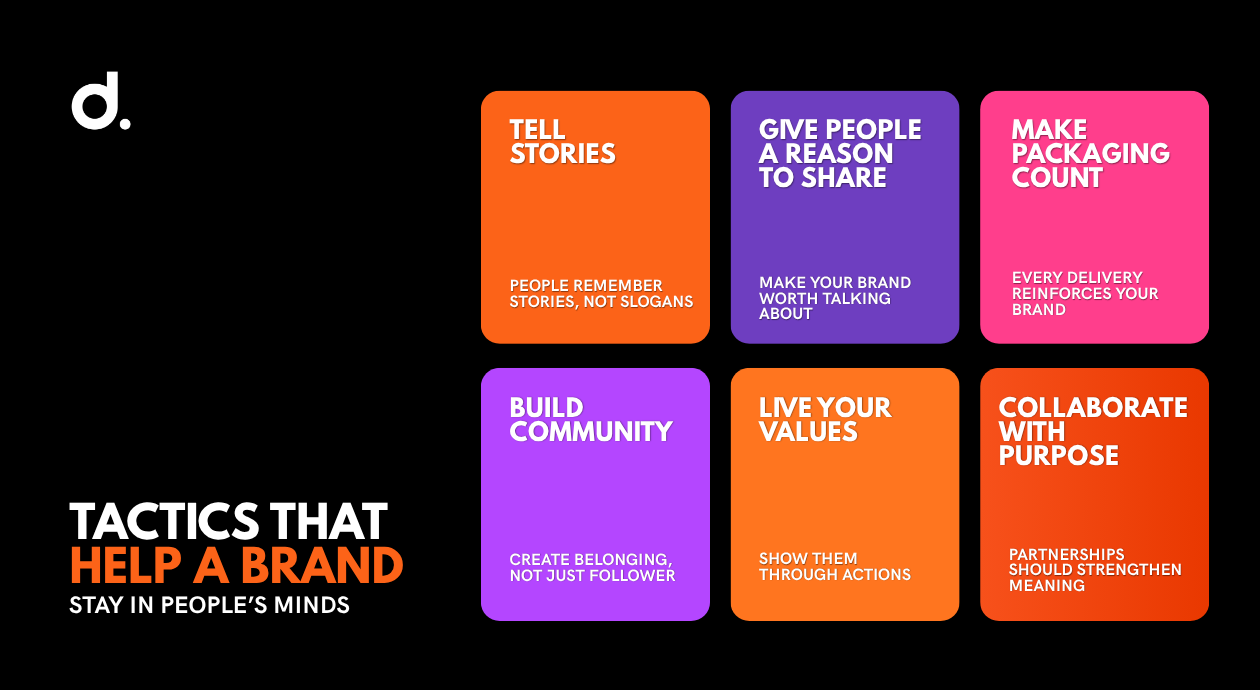
Tactics That Help a Brand Stay in People’s Minds
Strategy and identity form the foundation.
Memorability grows when customers experience that foundation through useful, emotional, social, and physical touchpoints.
Tell Stories Customers Can Repeat
A useful brand story should be easy for another person to summarise.
Ask:
- Can someone explain why the company exists?
- Is there one belief or tension at the centre?
- Does the story connect to the product or experience?
- Is it supported by how the company behaves?
- Can customers see themselves inside it?
Do not force every piece of content into a dramatic narrative.
Use stories when they make the brand easier to understand.
These may include:
- Founder stories
- Customer transformations
- Product-development stories
- Employee experiences
- Supplier relationships
- Lessons from failed attempts
- Decisions the business made differently
- The history behind a process or product
A story becomes a branding asset when it reinforces what you want the company to be known for.
Give Customers Something Worth Sharing
User-generated content makes customers participants in the brand rather than passive observers.
Tower 28 offers a strong example.
During the COVID-19 pandemic, the brand sent its SOS facial spray to healthcare workers experiencing mask-related skin irritation. Recipients shared before-and-after images, and Tower 28 requested permission to use those real customer experiences on its website and social channels. The result gave the brand credible proof that looked and sounded different from a polished advertising claim.
You cannot demand organic advocacy.
You can create conditions that make it more likely:
- Build a product worth discussing.
- Make the experience visually shareable.
- Ask for reviews at the right moment.
- Feature customers respectfully.
- Seek permission before republishing content.
- Give people a clear prompt.
- Respond when customers mention the brand.
- Make the customer look good for sharing.
Digital Shaping can connect this kind of participation with a broader social media strategy, so customer stories reinforce the same identity instead of becoming disconnected posts.
Treat Packaging as Part of the Brand
For ecommerce brands, packaging may be the first physical experience a customer has with a company.
Shopify’s branding reporting quotes Britt Martin of custom packaging company Arka describing the package as a customer’s first physical touchpoint with the brand. The outside of the box, the material, the opening experience, the copy, and the product presentation all continue the promise made online.
Packaging does not need to be expensive to be recognizable.
It can use:
- A signature colour
- A repeated phrase
- Distinctive labels
- Thoughtful inserts
- Clear product instructions
- A consistent opening sequence
- A useful reusable feature
- An identifiable material or texture
The key is continuity.
A premium digital identity followed by careless packaging weakens the brand promise.
Build a Community Around Something Real
A community cannot be built around the instruction “engage with us.”
People gather around:
- Shared interests
- Shared problems
- Shared identities
- Shared ambitions
- Education
- Entertainment
- Access
- Recognition
- A belief or cause
Decide what customers gain from participating with one another, not only what the company gains from their attention.
For a consumer brand, that might be a shared lifestyle, creative interest, or product ritual.
For a B2B company, the community may form around professional education, practical templates, industry changes, or peer support.
Do not call an audience a community before members have a reason to connect.
Commit to Values You Can Demonstrate
Values can strengthen brand identity when they influence real decisions.
They weaken trust when they exist only as website language.
Edelman’s 2025 Brand Trust report found that 80% of respondents trusted the brands they personally used. It also found that trust increasingly depends on relevance, responsiveness, culture, community, and clear action rather than broad purpose statements alone. Seventy-three percent said their trust would increase when a brand authentically reflected current culture.
Choose commitments connected to your operations.
A value may affect:
- Sourcing
- Hiring
- Accessibility
- Pricing
- Customer policies
- Product design
- Partnerships
- Environmental impact
- Community investment
- How mistakes are handled
Customers notice the gap between a stated value and the actual experience.
Purpose becomes memorable when people can see it operating.
Collaborate With Brands That Strengthen Your Meaning
The best brand collaborations do more than combine audiences.
They create a new product, experience, or idea that makes sense for both identities.
Shopify’s reporting on Fishwife and Fly By Jing describes how the two brands combined tinned seafood with chilli crisp and Sichuan flavours. Fishwife cofounder Becca Millstein said the partnership allowed the younger company to gain credibility through association with a brand that had established its reputation earlier.
A useful collaboration should answer:
- Do the audiences overlap meaningfully?
- Do the brands share compatible values?
- Does each partner bring something the other lacks?
- Will the result feel natural rather than forced?
- Can both brands remain recognizable?
- Is there a clear customer benefit?
Borrowed attention disappears quickly.
Borrowed meaning can strengthen how people remember both brands.
Does Brand Building Work Differently for B2B and Consumer Companies?
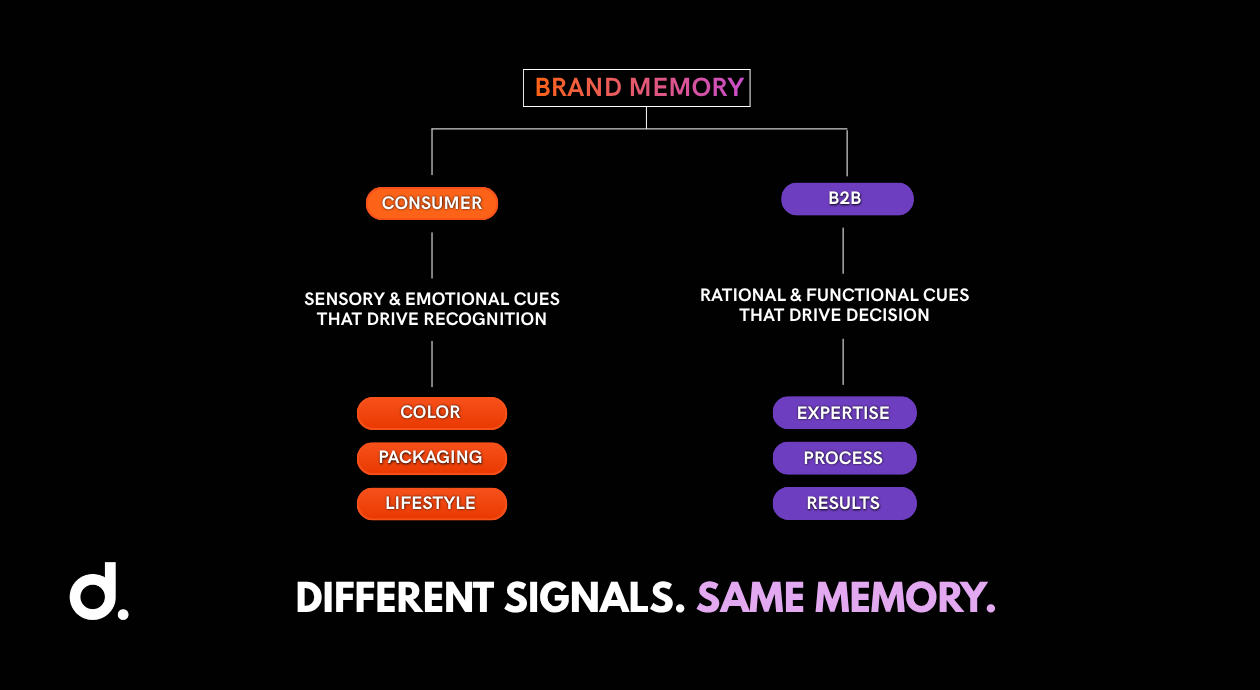
The basic memory principles remain the same.
Both B2B and consumer brands need to be distinctive, consistent, relevant, and repeatedly visible.
The strongest memory cues often differ.
| Consumer brands | B2B and service brands |
|---|---|
| Colour and packaging | Positioning and expertise |
| Product design | Named process or methodology |
| Influencer and customer content | Case studies and client proof |
| Retail and unboxing experience | Sales and onboarding experience |
| Community identity | Industry point of view |
| Sensory associations | Reliable communication |
| Lifestyle storytelling | Specific business outcomes |
Consumer Brand Memorability
Consumer brands often have more opportunities to create sensory recognition.
A customer may remember:
- Package shape
- Colour
- Scent
- Store environment
- Product texture
- Illustration
- Creator partnerships
- Social tone
- Unboxing experience
The brand may also become part of how customers express taste, values, identity, or membership.
That makes visual identity and community especially powerful.
B2B and Service Brand Memorability
B2B brands are less likely to be remembered because of a package on a shelf.
They are remembered because they repeatedly own a specific idea or deliver a distinctive experience.
For example:
- The agency that explains attribution without hiding behind dashboards
- The software company known for the fastest implementation in its category
- The consultant with a named framework for solving one expensive problem
- The accounting firm built specifically for companies at a defined growth stage
- The law firm that explains complex decisions in plain language
In B2B, every person becomes part of the brand.
The speed of the first reply matters.
The quality of the sales call matters.
The clarity of the proposal matters.
The onboarding experience matters.
The report the customer receives three months later matters.
A memorable message cannot compensate for a forgettable or frustrating delivery experience.
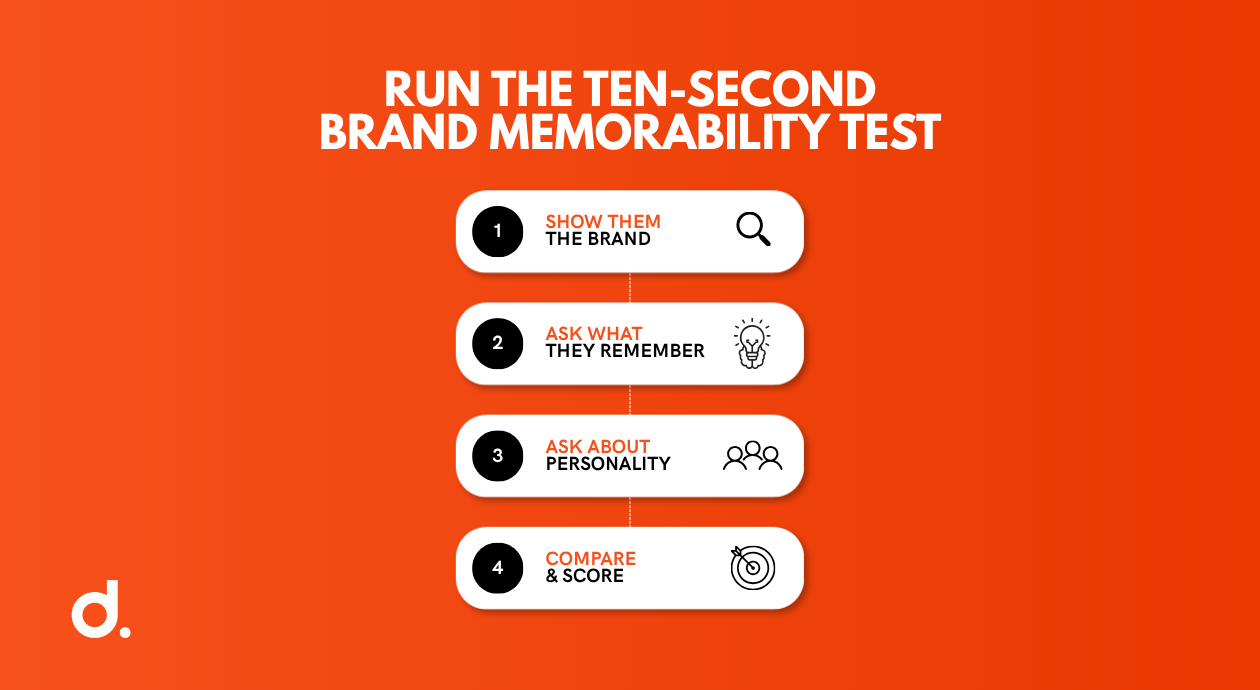
Run the Ten-Second Brand Memorability Test
You do not need a large research budget to identify obvious memorability problems.
Run this simple test with five people who fit your general audience but do not already know the brand.
Step 1: Show Them the Brand
Show each participant:
- Your homepage
- Your logo
- One social post
Give them ten seconds.
Then remove everything.
Step 2: Ask What They Remember
Do not provide hints.
Ask:
- What do you remember seeing?
- What do you think the business does?
- Who do you think it serves?
- What colour or visual detail do you remember?
- What words or messages stood out?
Write down their exact answers.
Do not correct them.
Step 3: Ask Them to Describe the Personality
Ask:
If this brand were a person, how would you describe it to a friend?
Listen for specific language.
“Confident, straightforward, and slightly rebellious” gives you something useful.
“Professional,” “nice,” or “modern” may suggest the identity is acceptable but generic.
Step 4: Compare Their Answers With Your Strategy
Review whether people remembered:
- The intended audience
- The positioning
- The category
- The main difference
- The visual cue
- The intended personality
Use a simple score:
| Result | Meaning |
|---|---|
| They remembered the name, offer, difference, and personality | Strong foundation |
| They understood the service but remembered no distinctive feature | Clarity without memorability |
| They remembered the visual identity but misunderstood the offer | Design without positioning |
| They described the brand using generic words | Distinctiveness problem |
| Each person understood something different | Consistency or messaging problem |
| They could not explain what the business does | Fundamental clarity problem |
| Run the same exercise with your three closest competitors. |
If the descriptions sound interchangeable, more advertising will not solve the underlying issue.
You need a clearer position.
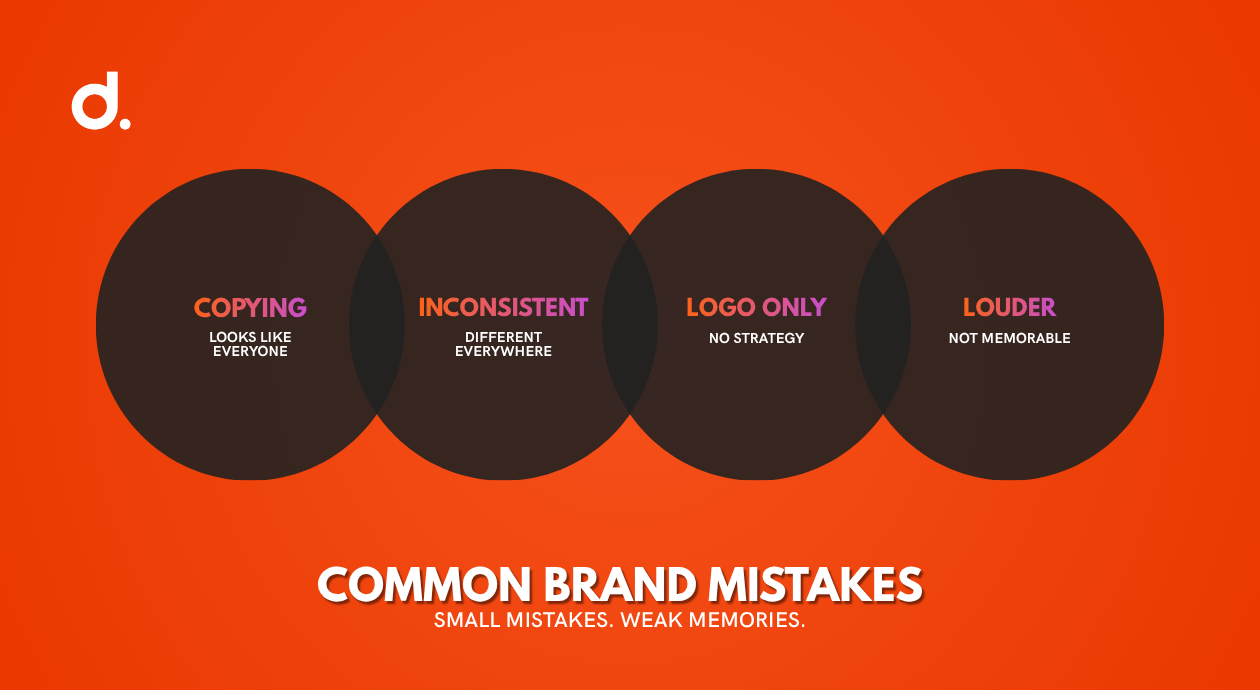
Common Mistakes That Make a Brand Forgettable
Copying the Category
Looking like the market leader may feel safe.
It also makes your brand easier to confuse with everyone else.
Learn category conventions, then decide which ones customers genuinely need and which ones you can challenge.
Changing the Identity Across Channels
A different voice, palette, message, and company description on each platform prevents recognition from accumulating.
Adapt the execution.
Keep the identity.
Treating the Logo as the Brand
A logo is a recognition device.
It cannot define your positioning, improve the customer experience, or make an unclear offer meaningful.
Choosing Aesthetics Before Strategy
A visually beautiful brand can still be generic.
Design should express a clear idea, not replace one.
Rebranding Too Frequently
Recognition takes time.
Businesses sometimes abandon an identity because the internal team has become bored with it, even though customers are only beginning to recognize it.
Change when the strategy, market, audience, offer, or business has changed enough to justify it.
Do not rebrand because the team wants something new to post about.
Ignoring Employees
Customers experience the brand through people.
If employees do not understand the positioning, values, tone, and customer promise, external consistency will eventually break.
Internal brand education is not only for large companies.
Making Claims the Experience Cannot Support
A brand that promises simplicity but has a confusing buying process will be remembered for the contradiction.
A brand that promises personal service but sends generic replies weakens its own positioning.
The customer experience is where the brand promise becomes believable or collapses.
Trying to Be Memorable by Being Loud
Louder colours, more aggressive claims, and constant trend participation can attract attention without creating the right memory.
People may remember the content and forget who posted it.
Memorability requires distinctive ownership, not noise.
Frequently Asked Questions
How do you build a brand people remember?
Start with clear positioning, a specific audience, and a real reason for the business to exist. Express that strategy through a distinctive visual and verbal identity, then use it consistently across the website, content, social media, advertising, sales, and customer experience. Memorability grows through distinctiveness combined with repeated recognition.
Why is brand consistency important?
Consistency allows separate customer interactions to build on one another. When the logo, colours, tone, positioning, and promise remain recognizable, repeated exposure strengthens familiarity. When those elements change from one channel to another, customers have to reinterpret the business each time instead of forming a stable memory.
How many times must someone see a brand before remembering it?
There is no scientifically fixed number. The often-repeated five-to-seven-impression claim comes from an advertising rule of thumb rather than a universal modern study. The number varies by product, customer, market, message, and purchase risk. What research supports more clearly is that repeated exposure can strengthen familiarity and recognition.
What makes a logo memorable?
A memorable logo is simple enough to recognize quickly, distinctive enough not to blend into the category, and flexible enough to work at different sizes and across different applications. It should support the brand’s personality rather than rely on unnecessary complexity or a hidden visual trick.
How do small businesses build brand awareness?
Small businesses can build brand awareness by repeatedly using the same positioning and identity across a focused set of channels. Useful content, local visibility, partnerships, referrals, customer stories, social media, email, packaging, events, and paid advertising can all contribute when they reinforce one recognizable brand.
Does brand building work differently for B2B companies?
The core principles remain the same, but the strongest cues differ. Consumer brands often rely more on packaging, colour, visual identity, and community. B2B brands are frequently remembered through specific positioning, thought leadership, case studies, a named process, reliable communication, and the customer’s direct experience of the sales and delivery process.
Is a brand more than a logo?
Yes. A logo is one visual identifier. The brand also includes positioning, reputation, customer expectations, voice, values, messaging, design, service, sales experience, product quality, and every interaction through which people learn what the business represents.
Memorable Brands Are Built, Not Discovered
Memorability is not a lucky creative accident.
It is the predictable result of making clear choices and repeating them long enough for recognition to form.
Know who the brand is for.
Decide what it should be known for.
Make that position meaningfully different.
Create a visual and verbal identity that expresses it.
Use that identity consistently.
Then deliver an experience that proves the promise was real.
Start this week with the ten-second test.
Show your homepage, logo, and one social post to someone unfamiliar with the business. Ask what they remember.
Their answer will tell you more than another internal discussion about whether the logo feels modern enough.
Digital Shaping helps businesses turn unclear positioning and disconnected visuals into a brand system people can recognize, understand, and trust.
Explore Digital Shaping’s Brand Strategy and Identity service or show us what is missing.
One conversation, no pressure.