
How to Rank on AI Search Engines in 2026

Ranking on AI search engines means making your content eligible to be retrieved, understood, and cited when an AI system builds an answer. The strongest starting point in 2026 is still good SEO: useful original content, crawlable pages, clear site structure, and trustworthy information. Several popular “AI SEO” hacks are either unproven or, for Google specifically, unnecessary.
That answer is less exciting than most AEO playbooks.
It is also easier to defend.
AI search optimization has become crowded with new terms, checklists, files, schemas, prompt tricks, and claims that one small technical change will make ChatGPT, Google AI Overviews, or Perplexity start citing a site.
Some of the advice is reasonable. Some is platform-specific. Some is repeated so often that it sounds established even when no platform has confirmed it.
The useful question is not “what are the 27 newest GEO tactics?”
It is: what can we verify, what is merely plausible, and what should a business actually do first?
That is the approach here.
What “Ranking” on an AI Search Engine Actually Means
Traditional search gives us a familiar picture: a query, a ranked list, and a position.
AI search is messier.
A system may retrieve several pages, extract only one passage from each, generate an answer from the combined material, and then show a smaller set of citations. A page can rank well in ordinary search and never become a citation. Another page can appear inside an AI answer even when it is not the first blue link a user would have clicked.
For Google’s own generative search features, the mechanism is unusually well documented.
Google’s current guide to generative AI search says AI Overviews and AI Mode are rooted in its core Search ranking and quality systems. It describes two important mechanisms:
- Retrieval-augmented generation, or RAG: Google retrieves relevant, current pages from its Search index and uses information from those pages to ground an AI response.
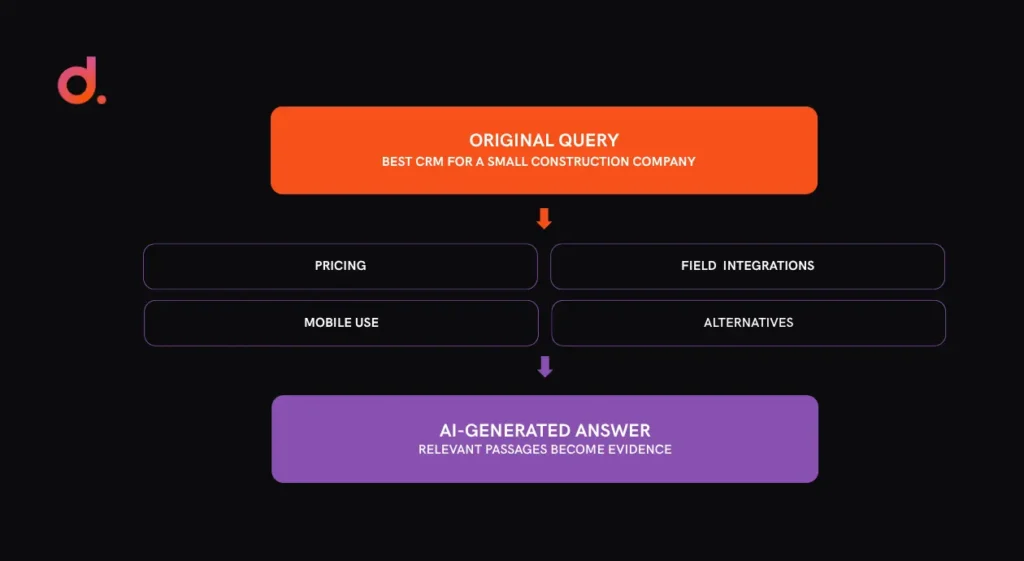
- Query fan-out: the system can generate several related searches around the original question so it can gather a broader set of information.
That changes what “ranking” means.
You are not only trying to be the best page for one exact keyword. You are trying to be a useful source across the connected questions the system may need to answer.
For a query such as “best CRM for a small construction company,” fan-out might explore pricing, field-service integrations, mobile use, team size, implementation, and alternatives. A generic page titled “Best CRM Software” may cover the head term but contribute little to the actual answer.
AI search visibility therefore depends on two separate achievements:
- Retrieval: can the system find and select the page?
- Citation usefulness: does the page contain information worth carrying into the answer?
The second part is where a lot of thin “AI-optimized” content fails.
What Google Itself Says You Can Ignore
This is where the 2026 conversation gets interesting.
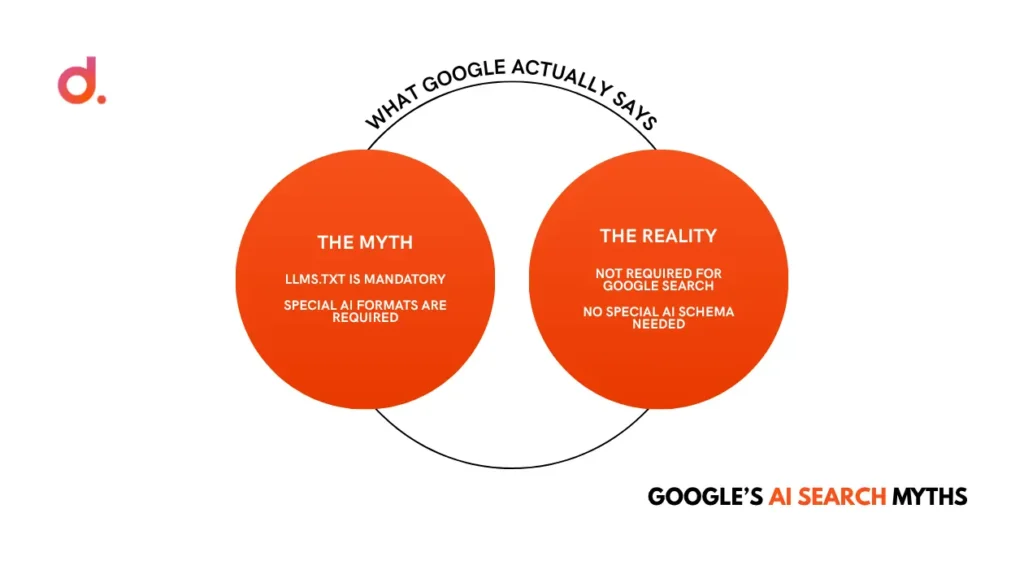
Google published a dedicated mythbusting section in its AI search guidance, and several items directly contradict tactics commonly sold as universal GEO requirements.
For Google Search specifically, its current guidance says:
| Common Recommendation | What Google says for AI Overviews and AI Mode |
|---|---|
| Create an llms.txt file | Google Search does not use it. Maintaining one for other services is fine, but it neither helps nor hurts Google Search visibility. |
| Break every page into tiny “AI-friendly” chunks | There is no requirement to chunk content. Page length should follow the audience and subject. |
| Rewrite normal content into a special AI format | Not necessary. Google’s systems understand synonyms and general meaning. |
| Manufacture third-party mentions | Inauthentic mentions are not a useful shortcut and can run into Google’s quality and spam systems. |
| Add special AI schema | There is no special schema required for generative AI search. Structured data can still be useful for ordinary rich-result eligibility. |
This does not mean technical SEO, structured data, or third-party authority are worthless.
It means you should stop turning every broadly useful SEO practice into a made-up AI ranking factor.
Organization schema can still clarify information for normal search features. Reviews and independent coverage can still matter to reputation and discovery. Clear sections can still help readers. None of that requires pretending Google has confirmed a special “GEO boost” for the tactic.
If someone tells you a file is mandatory for AI visibility, the first question should be simple:
Mandatory for which platform, according to whom?
Why Google’s Advice Does Not Automatically Apply to ChatGPT or Perplexity
Google’s documentation is authoritative for Google.
It is not a universal specification for every AI search product.
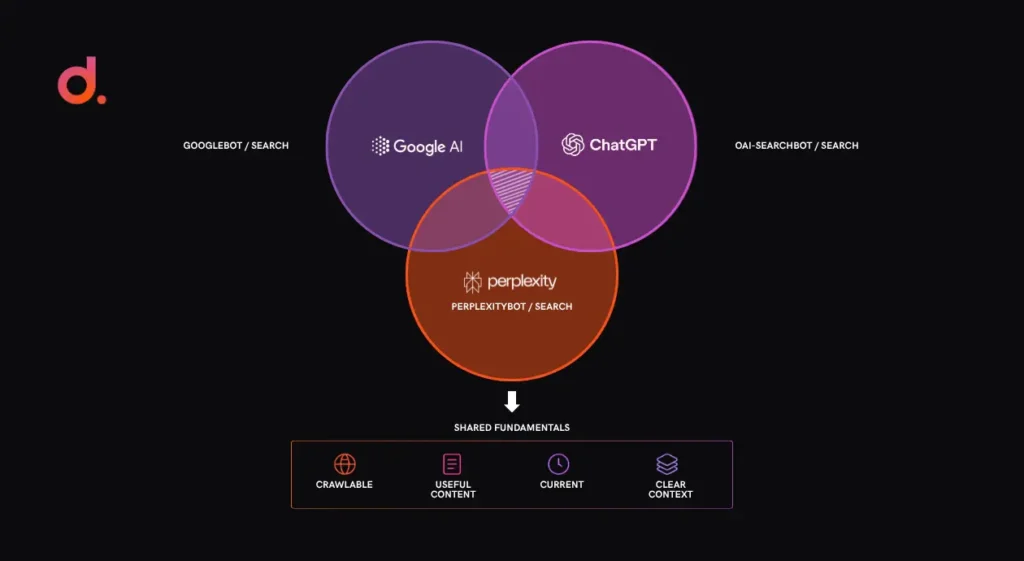
OpenAI and Perplexity operate their own search and crawling systems. The practical overlap is significant, but the published rules are not identical.
OpenAI’s current publisher guidance says any public website can appear in ChatGPT search. It recommends allowing OAI-SearchBot if a publisher wants site content to be discoverable for summaries, citations, and links.
Perplexity describes itself as a live-web answer engine. Its current crawler documentation recommends allowing PerplexityBot for sites that want to appear in search results. Its help center also says Perplexity searches current web sources and provides citations.
The overlap is obvious:
- Make important pages public and crawlable.
- Publish information that directly answers real questions.
- Keep facts current.
- Give systems enough context to understand what the page is about.
- Build a web presence that does not depend on your own site making unsupported claims about itself.
The difference is equally important: Google explicitly tells site owners that several AI-specific hacks are unnecessary for its product, while other platforms publish less detailed ranking guidance.
Where official evidence stops, say so.
A tactic can be worth testing without being promoted as a proven ranking factor.
The Foundational Moves That Still Hold Up
After removing the hype, most durable AI search work looks suspiciously like strong search, content, and brand work.
That is not a weakness.
It is a useful filter.
Publish Non-Commodity Content
Google’s current AI guide puts unusual emphasis on content that adds something the rest of the web does not already say.
That matters because an answer engine does not need fifty near-identical summaries of the same seven tips.
It needs sources that contribute information.
A commodity article says:
“To improve ecommerce conversion, use good images, reviews, and clear CTAs.”
A more useful article might show:
- A teardown of ten real product pages in one category.
- Before-and-after checkout data from a genuine test.
- A field guide to diagnosing mobile payment failures.
- Original survey findings.
- A practitioner explaining the trade-offs of a real implementation.
- A comparison that names where each option is weak, not just where it is strong.
The point is not to sound clever.
The point is to give the retrieval system a reason to use your page rather than another summary.
This is also why mass-producing one page for every fan-out variation is risky. Google’s guidance explicitly warns against creating large numbers of pages mainly to manipulate rankings or generative responses.
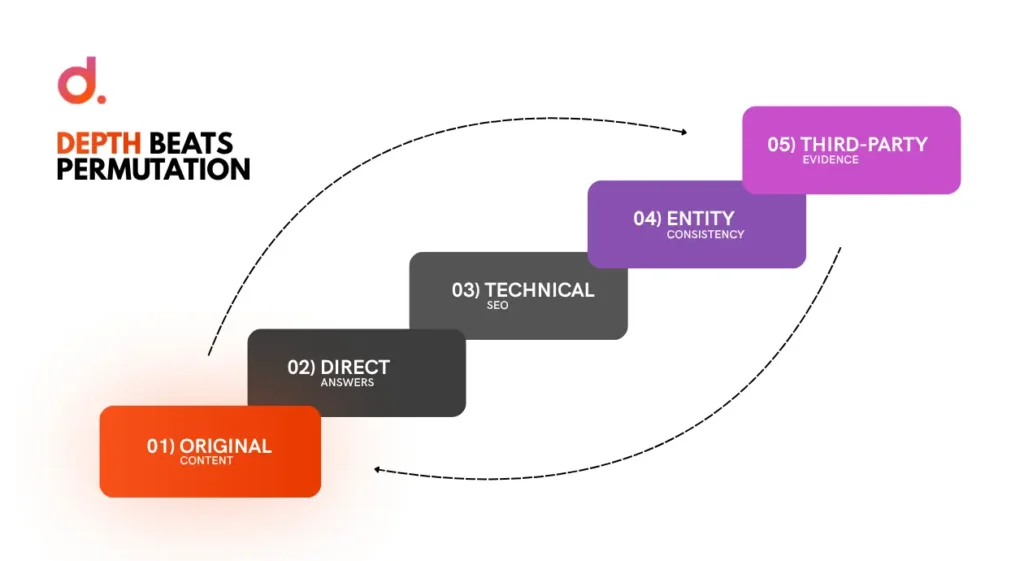
Depth beats permutation.
Answer the Question Before You Expand It
A reader should not need six paragraphs to find the answer to a heading.
Neither should a retrieval system.
Use a simple editorial rule: the first sentence under an H2 or H3 should answer the question implied by that heading. Then add nuance, evidence, examples, and exceptions.
For example:
Do you need llms.txt for Google AI Overviews?
No. Google says Google Search does not use llms.txt, although other systems may choose to use the convention.
Then explain the context.
This is good AEO structure because it is good writing structure.
Make the Technical Foundation Boringly Reliable
A page cannot become a useful Google AI citation if Google cannot index it properly.
Google’s guidance says pages need to be indexed and eligible to appear with a snippet to be eligible for its generative features. It also continues to recommend standard crawling, JavaScript, duplicate-content, and page-experience practices.
For other AI search systems, check crawler access separately.
A practical technical review should include:
- robots.txt rules.
- CDN and WAF bot blocking.
- Canonical tags.
- Indexability.
- JavaScript rendering where important content depends on it.
- Redirect chains.
- Duplicate URLs.
- Mobile usability.
- Page speed and reliability.
- Sitemap health.
Do this before debating whether an FAQ should contain 42 or 55 words.
A blocked crawler does not care how beautifully the paragraph was optimized.
Keep Entity Facts Consistent
AI systems routinely answer brand questions that require basic factual confidence.
What does the company sell? Where does it operate? Which product names are current? Who founded it? What is included in a plan? Is an old integration still supported?
Make those facts easy to find on your own site and consistent across the places you control.
Useful pages include:
- A specific About page.
- Current product and service pages.
- Clear pricing or pricing-explanation pages.
- Author pages where expertise matters.
- Contact/location information.
- Policies and documentation.
- Updated comparison and integration pages.
Structured data can support normal SEO and machine readability when it accurately reflects the visible page. Do not use markup to invent authority the page itself does not demonstrate.
Earn Third-Party Evidence Honestly
Your own website can explain what you do.
It cannot independently prove that customers, journalists, reviewers, researchers, or the market agree.
Third-party sources matter because many recommendation-style AI answers pull from a mix of first-party and independent evidence.
The right source depends on the category.
A SaaS product may need credible reviews, technical comparisons, integration documentation, and practitioner discussion. A consumer product may benefit more from independent testing, reputable editorial coverage, retailer reviews, and real customer feedback. A professional service may depend heavily on named expertise, case studies, industry publications, and local reputation.
Do not turn this into a link-building scavenger hunt.
Ask a better question: where would a skeptical customer go to verify us?
Those are the places worth earning a real presence.
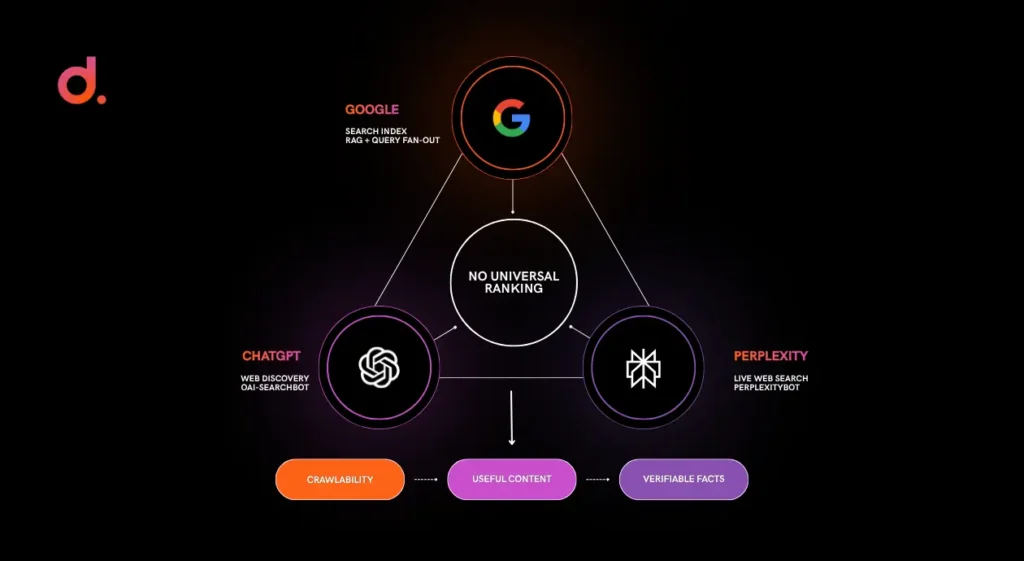
The Major AI Search Platforms Do Not Have One Shared Ranking Formula
Treat “AI search” as a category, not a single engine.
| Platform | What we can verify publicly | Practical implication |
|---|---|---|
| Google AI Overviews / AI Mode | Grounded in Google’s Search index and core ranking systems using RAG and query fan-out. | Strong SEO foundations and Google eligibility remain central. |
| ChatGPT Search | Public websites can appear; OpenAI recommends allowing OAI-SearchBot for discovery in search summaries and citations. | Check crawler access and create pages useful enough to cite. |
| Perplexity | Searches the live web, cites sources, and operates PerplexityBot for search indexing. | Current, crawlable, source-worthy pages matter. |
Notice what is missing from the table.
There is no universal score showing that “schema = 14%,” “Reddit mentions = 21%,” or “FAQ blocks = 9%.”
If a vendor publishes percentages like that, look for the methodology: query set, time period, geography, model version, sample size, and how a citation was counted.
Without that, a precise number is still just a claim wearing a tie.
Be Careful With AI Overview Statistics
Even reputable studies can produce very different headline numbers.
Ahrefs analyzed 146 million desktop SERPs from September 2025 and reported that AI Overviews appeared for about 21% of the keywords in that dataset, with much higher rates for question-style queries. Its methodology and breakdown are public.
Surfer has published research from more than 400,000 searches reporting AI Overviews across roughly 47% of its sampled queries, with a strong informational-query skew.
Those figures are not close.
That does not automatically mean one study is wrong.
Different tools can sample different keywords, countries, dates, devices, intents, and result types. Google is also changing the product while the studies are being conducted.
The lesson is not “never use statistics.”
It is: name the source, date, sample, and scope whenever the number matters.
For your own strategy, the percentage of all global queries that contain an AI Overview is less useful than a simpler question:
How many of the queries that actually matter to your business produce an AI answer, and which sources are being cited?
Measure that directly.
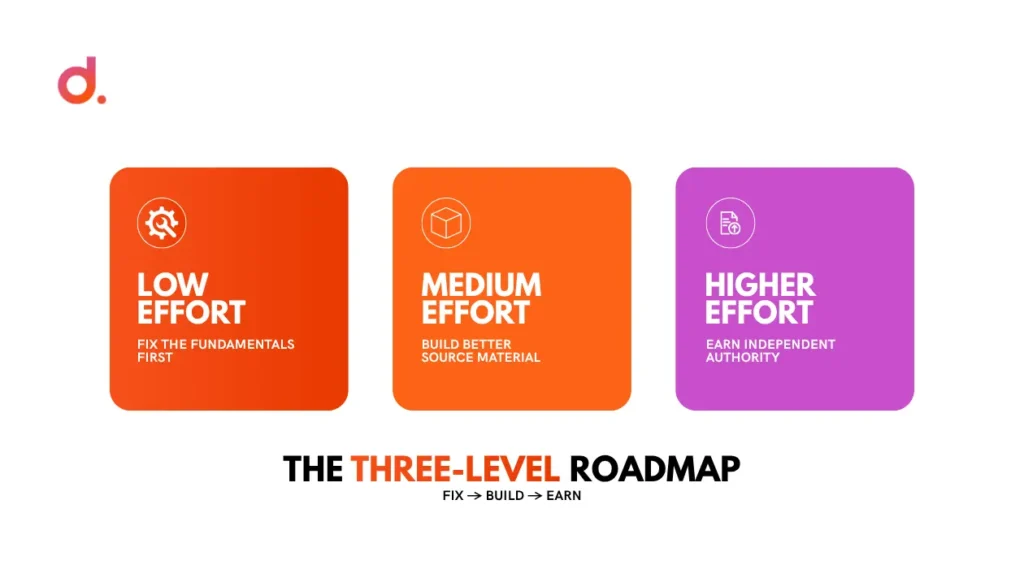
A Practical AI Search Optimization Plan by Effort Level
Do not begin with a new technology stack.
Start with the work most likely to improve both traditional and AI search.
Low Effort: Fix These First
1. Audit crawler access.
Check Googlebot, OAI-SearchBot, and PerplexityBot against robots rules, CDN settings, and WAF logs where available.
2. Rewrite weak section openings.
Make the answer clear in the first sentence, then expand it.
3. Update stale money pages.
Old pricing, dead integrations, discontinued products, and 2023 comparisons are weak source material in 2026.
4. Add the source behind important statistics.
A number without provenance is harder to trust and easier to misquote.
5. Remove fake specificity.
If the business does not have evidence for “#1,” “best,” “industry-leading,” or a performance percentage, rewrite the claim.
Medium Effort: Build Better Source Material
1. Improve entity pages.
Give the company, products, experts, locations, and policies clear canonical homes.
2. Build decision content.
Create genuinely useful comparisons, alternatives, implementation guides, pricing explainers, and use-case pages.
3. Add original evidence.
Publish small studies, customer research, test results, expert analysis, benchmarks from your own transparent dataset, or detailed case studies.
4. Strengthen internal linking.
Connect explanatory content to the product, service, case study, and documentation pages that prove the answer.
For businesses that need help turning this into a coherent search program, Digital Shaping’s SEO services focus on technical visibility, content structure, intent, and the commercial journey rather than treating AI search as a separate bag of tricks.
Higher Effort: Build Authority the Site Cannot Manufacture Alone
1. Earn independent coverage.
Pitch original data, real expertise, and stories worth reporting.
2. Develop category-level authority.
A connected body of strong pages is harder to build than a one-off “best X” post, but it gives retrieval systems more evidence across related questions.
3. Test disputed channels rather than arguing from attribution.
If the business is making large budget decisions based on AI referrals, brand mentions, PR, or content, use experiments and business outcomes where possible instead of assuming citation volume equals revenue.
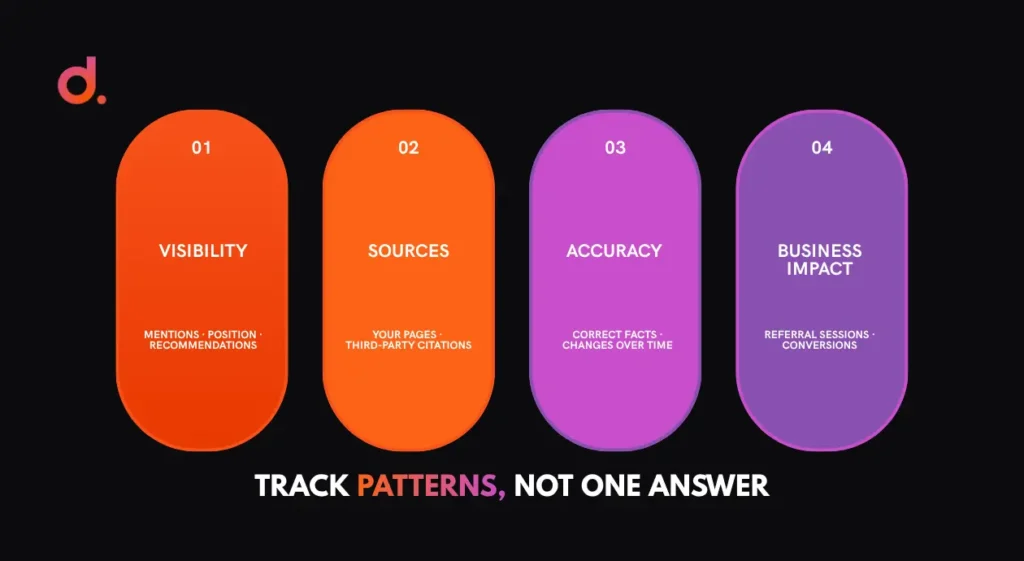
How to Measure Whether AI Search Work Is Actually Working
Visibility without measurement becomes another vanity metric.
For Google, there is now an official answer. Google’s AI optimization guide points site owners to the Generative AI performance report in Search Console for performance in generative Search features.
For ChatGPT and Perplexity, build a smaller manual audit alongside analytics referral data.
Choose 20 to 50 commercially meaningful prompts or query themes and run them on a fixed schedule.
Track:
- Whether the brand is mentioned.
- Whether it is recommended or merely cited.
- Which page from your site appears.
- Which third-party sources appear.
- Whether the information is accurate.
- Whether the answer has changed since the previous review.
- Referral sessions and downstream conversions where analytics can capture them.
Do not judge success from one prompt.
AI answers are dynamic. Different wording can trigger different retrieval. Search indexes change. Sources update.
Look for patterns over time.
Then connect visibility to commercial behavior.
If citations rise but qualified traffic does not, investigate why. If ChatGPT referrals are small but convert unusually well, that may justify more attention. If a competitor dominates recommendation queries because independent review sites repeatedly support them, publishing twelve more self-authored listicles probably will not fix the gap.
The point of measurement is to tell you what to do next.
Frequently Asked Questions
How do AI search engines decide what to cite?
AI search systems generally retrieve relevant web information and use it to ground generated answers, but each platform has its own search and citation logic. Google publicly documents RAG and query fan-out for AI Overviews and AI Mode. ChatGPT and Perplexity also use web search, but businesses should not assume one universal ranking formula applies across all platforms.
Do I need an llms.txt file to rank in AI search?
Not for Google Search. Google’s current guidance says it does not use llms.txt for AI Overviews, AI Mode, or normal Search rankings. Other services may choose to support the convention, so maintaining one can be an optional experiment. It should not outrank crawlability, useful content, indexing, and factual accuracy on your priority list.
Does structured data help with AI search visibility?
Structured data remains useful for standard SEO when it accurately represents visible content and can support rich-result eligibility. Google specifically says structured data is not required for its generative AI search features and there is no special AI schema. Other platforms publish less specific guidance, so avoid presenting heavy schema work as a guaranteed AI citation tactic.
Is AI search optimization different from SEO?
Partly. The measurement surface is different because the goal may be a citation or recommendation inside a generated answer rather than a blue-link click. But the strongest verified foundations overlap heavily with SEO: crawlability, indexability, useful original content, clear site structure, accurate entity information, and legitimate authority. The “AI-specific” layer should come after those foundations.
How long does it take to rank in AI Overviews or AI answers?
There is no guaranteed timeline. A crawlable new or updated page can become retrievable relatively quickly, while authority, third-party evidence, and broad topical coverage take much longer to build. Measure a fixed set of important queries over time rather than promising a 30-, 60-, or 90-day AI ranking window that no platform guarantees.
The Best 2026 AI Search Strategy Is Less Exotic Than It Sounds
The temptation is to treat every new search interface as permission to rebuild the playbook from zero.
Google’s own guidance is telling site owners almost the opposite.
Create something worth retrieving. Keep it crawlable. Make the facts clear. Add experience or evidence the rest of the web does not already have. Earn genuine third-party support. Measure the queries that matter to your business. Be skeptical of tactics whose only proof is that five other marketing blogs repeated them.
Then test platform-specific additions where there is a real reason to do so.
A specific tactic being popular is not the same as a specific tactic being verified.
Start this week with the simplest check: open your most commercially important page, confirm it can be crawled and indexed, and ask whether it contains anything an AI answer would genuinely need to cite.