
How to Increase Marketing ROI Without Spending a Dollar More
You can increase marketing ROI without increasing the budget by getting more from the money already committed. The highest-leverage moves usually fall into three buckets: reallocate spend away from weak activity, fix free configuration problems inside tools you already pay for, and improve measurement so revenue is credited and optimized correctly.
Most “increase marketing ROI” advice quietly means “spend more intelligently.”
That is not the same thing as spending more.
If you are already paying for media, software, people, and agency support, there is usually a lot of room between the current return and the return the same budget could produce.
Sometimes the leak is obvious: one campaign is burning money.
Sometimes it is embarrassingly small: the wrong conversion action is set as primary in Google Ads, a mobile form is broken, the CRM does not pass revenue back to the campaign, or half your email list receives the same message even though their behavior is completely different.
None of those fixes requires a larger budget.
They require attention.
What “Without Spending a Dollar More” Actually Means
This article is not pretending marketing improvements are free labor.
Someone still has to inspect the data, make changes, write the email, fix the landing page, or update tracking. Time has a cost.
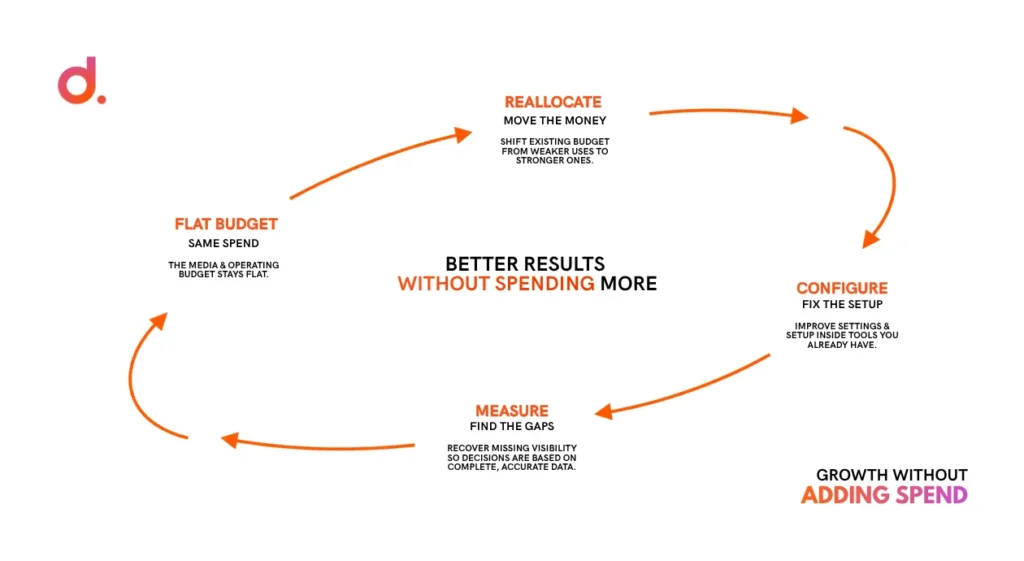
“Without spending more” means the media and operating budget stays flat. You improve the system using resources you already have rather than solving every problem by adding another campaign, tool, or agency line item.
There are three genuinely useful buckets.
Reallocation
Move existing money from weaker uses to stronger ones.
You are not increasing spend. You are changing where it works.
Configuration
Fix settings and setup inside tools you already have: conversion actions, exclusions, audience rules, tracking parameters, email automations, reporting fields, or page-level friction.
Measurement
Recover visibility you are currently missing so the business stops making decisions from incomplete or duplicated data.
These are not glamorous growth hacks.
That is exactly why they are often available.
Get the Terms Right First: ROI vs. ROAS vs. MER
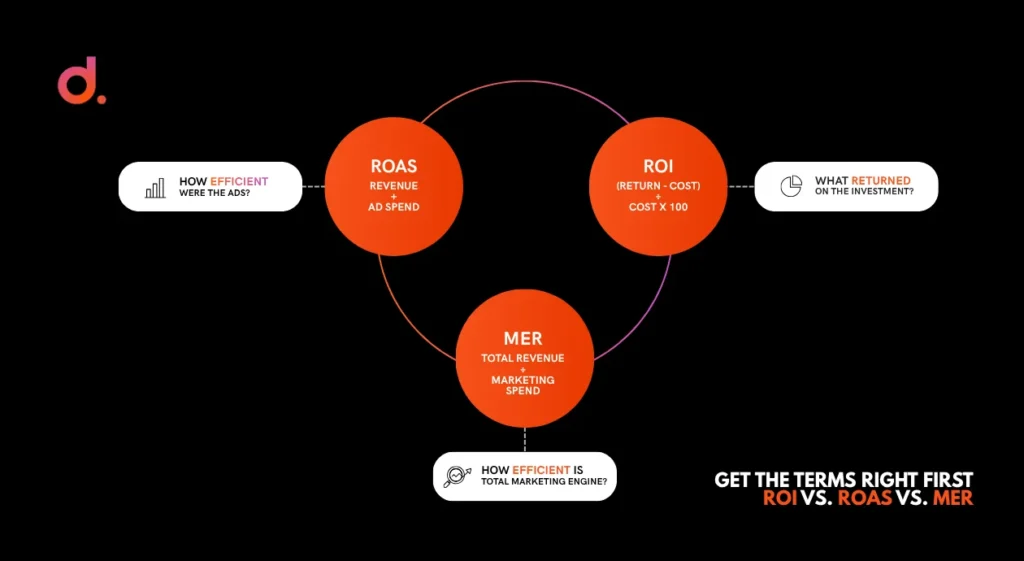
Teams regularly say “ROI” when they mean three different things.
| Metric | Basic formula | What it tells you | What it leaves out |
|---|---|---|---|
| ROAS | Revenue attributed to ads ÷ ad spend | Efficiency of paid media | Other marketing and operating costs |
| Marketing ROI | (Marketing return − marketing cost) ÷ marketing cost × 100 | Return relative to marketing investment | Depends heavily on how “return” and cost are defined |
| MER | Total revenue ÷ total marketing/ad spend | Blended business efficiency | Does not explain which channel caused the revenue |
Suppose you spend $10,000 on ads and those ads are attributed $40,000 in revenue.
ROAS is 4.0x.
That does not mean profit is $30,000.
The business still has product cost, shipping subsidies, returns, payment fees, salaries, software, creative production, agency costs, and possibly discounts.
If gross margin is 40%, the commercial picture is very different from a business with 85% gross margin.
When leadership asks for ROI, clarify whether the numerator is revenue, gross profit, contribution margin, or incremental profit.
A precise formula using the wrong economic input is still the wrong answer.
The Hidden ROI You’re Already Generating
One of the cheapest ways to “increase” measured ROI is to stop losing evidence of return you already create.
This does not create new revenue by itself. It changes what you can see and therefore what you optimize.
Examples:
- Sales calls close but never pass their source back to marketing.
- A lead becomes a customer three weeks later, but reporting stops at form submission.
- Offline invoices are not connected to CRM campaigns.
- Email influences repeat purchases but only first-order revenue is reported.
- Organic content creates branded demand that paid search receives last-click credit for.
- Campaign links lose UTMs during redirects.
- A migration changes source naming and creates a fake performance drop.
If revenue is disconnected from acquisition, the business often cuts the wrong thing.
That is a measurement leak, not a performance problem.
Reallocate What You Already Spend
The fastest ROI increase often comes from stopping the weakest use of the current budget.
The word weakest needs care.
Do not simply sort campaigns by platform ROAS and kill the bottom row. That can cut prospecting while protecting branded search and retargeting, which harvest demand created elsewhere.
Start with a business-level review.
Look for Spend That Produces Activity but Not Customers
Pull the last 60 to 90 days and connect each campaign to downstream outcomes.
For lead generation, compare:
- Spend.
- Leads.
- Qualified leads.
- Opportunities.
- Closed customers.
- Revenue.
- Gross or contribution margin if available.
A campaign with a $35 cost per lead may be worse than one with a $90 cost per lead if the cheaper leads never become customers.
For ecommerce, compare:
- Spend.
- New-customer orders.
- Returning-customer orders.
- Average order value.
- Discount use.
- Refunds/returns.
- Contribution margin.
Do not optimize the cheapest event if the business earns money several steps later.
Shift Budget, Do Not Just Cut It
If Campaign A has saturated its audience and Campaign B is constrained by budget while generating better qualified customers, move money.
If branded search already captures almost all available demand, adding another 20% may not create another 20% in sales.
If a Meta prospecting campaign generates buyers who later convert through branded Google searches, cutting Meta because Google looks better on last click can make the total business worse.
This is where paid advertising and attribution have to be reviewed together. Media allocation without funnel and revenue context is just spreadsheet tidying.
Put a Margin Guardrail on Every Reallocation
A same-budget shift only improves ROI if the destination produces a better business result, not merely a prettier platform metric.
Before moving money, write down the guardrail that cannot get worse. For ecommerce, that might be contribution margin after discounts and returns. For lead generation, it might be cost per qualified opportunity rather than cost per form submission. For a subscription business, it may be payback period or retained revenue instead of first-month acquisition volume.
This protects you from a common “optimization” that raises conversion rate by buying worse customers.
Suppose one campaign generates 100 orders at a lower cost than another, but those orders use deeper discounts and return products more often. Moving budget toward it may improve ROAS while reducing profit. The dashboard goes green while the business gets poorer.
Use the metric closest to money that you can reliably measure, and hold it beside the channel metric during reallocation.
Same budget is not the same thing as same economics.
Free Configuration Fixes Inside Tools You Already Use
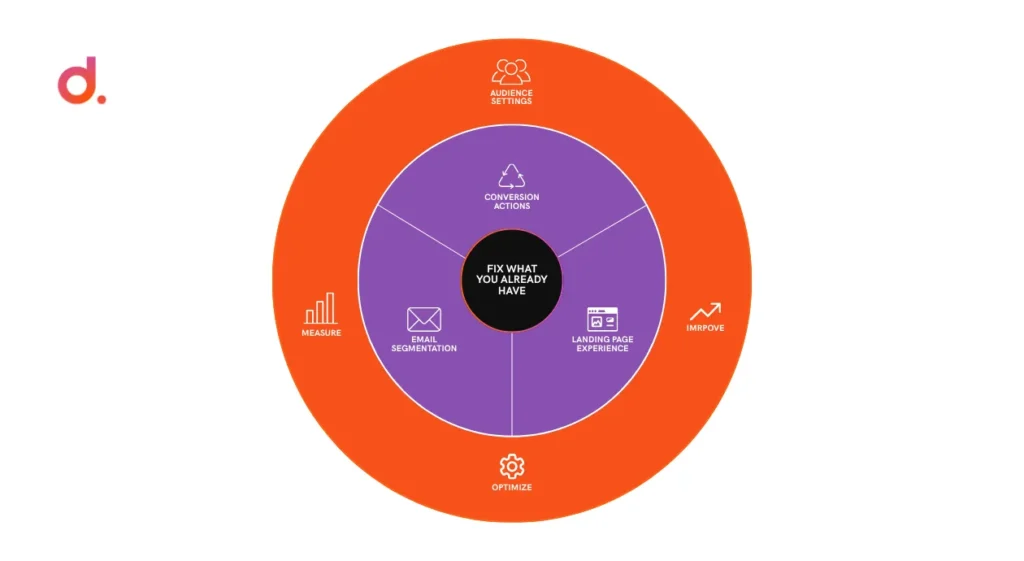
A surprising amount of budget gets wasted because the system is optimizing exactly what you told it to optimize.
The instruction was just wrong.
Audit Conversion Actions
In ad platforms, confirm which events are primary optimization goals.
If “view contact page,” “start form,” and “qualified lead” are all treated as equal conversions, the algorithm can chase cheap activity rather than commercial outcomes.
For ecommerce, make sure purchase value passes correctly and duplicate purchase events are not inflating results.
For lead gen, send qualified or closed outcomes back to the platform when the setup allows it.
Audit Location and Audience Settings
Campaign defaults can quietly broaden targeting.
Check:
- Geographic presence versus interest settings.
- Search partner/network settings.
- Audience expansion.
- Age or location exclusions.
- Existing-customer exclusions for acquisition campaigns.
- Brand exclusions where relevant.
- Negative keyword coverage.
Do not assume the setting you chose six months ago is still the setting now.
Clean Up Email Segmentation
Sending the same campaign to everyone feels efficient.
It often is not.
Use behavior you already collect:
- New subscriber.
- Viewed product but did not buy.
- First-time buyer.
- Repeat buyer.
- High-value customer.
- Lapsed customer.
- Category interest.
Better segmentation can improve revenue per send without adding a dollar of media spend.
If your store has cart and checkout abandonment, review whether the recovery flow is actually incremental rather than simply collecting attributed revenue. Digital Shaping’s email marketing services treat automation and segmentation as part of the revenue system, not an isolated open-rate exercise.
Fix the Highest-Friction Landing Page
You already paid for the click.
If the page after the click is weak, spending more just buys more exits.
Look for:
- Message mismatch between ad and page.
- Slow mobile load.
- A form asking for information sales does not need yet.
- Generic calls to action.
- Missing price context.
- Missing proof.
- Poor product imagery.
- Hidden shipping/returns information.
- A checkout error on one device or browser.
This is the core logic behind conversion rate optimization: improve what happens after the traffic arrives before buying more traffic.
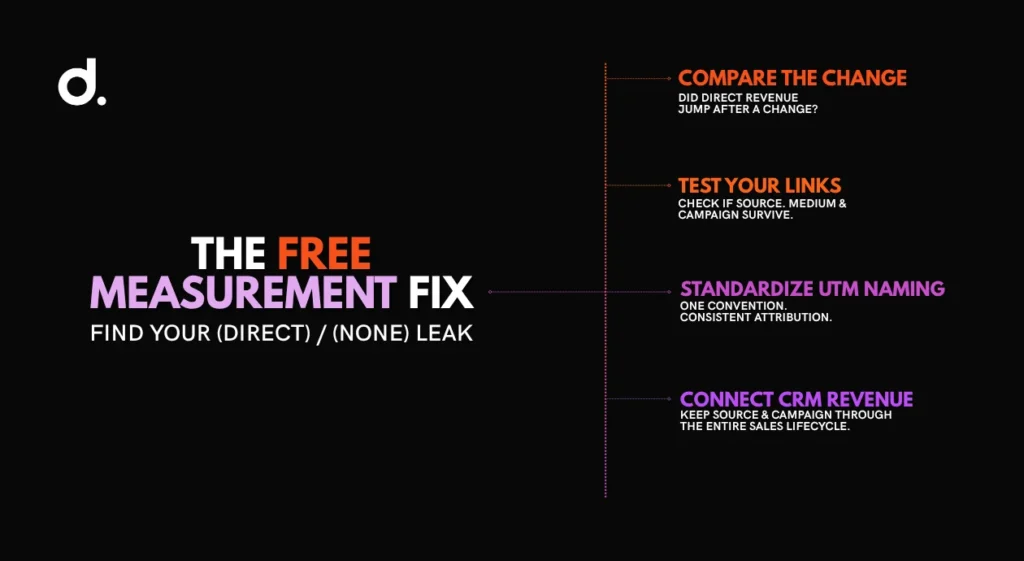
The Free Measurement Fix: Find Your (Direct) / (None) Leak
A jump in direct traffic can mean people know your brand.
It can also mean your attribution broke.
Google Analytics labels traffic (direct) / (none) when it has no clear referral or campaign information. Google’s current explanation lists reasons such as missing UTMs, redirects that remove tracking parameters, URL shorteners, bookmarks, typed URLs, privacy tools, and integrations that do not preserve campaign information.
Audit it.
Step 1: Compare the Change With Marketing Activity
Did direct revenue suddenly jump after a new email provider, checkout change, link shortener, app, or redirect was introduced?
That is a clue.
Step 2: Test Your Own Campaign Links
Click live links from email, paid social, influencer campaigns, QR codes, and partner placements.
Follow the redirect all the way through. Check whether source, medium, and campaign survive.
Step 3: Standardize UTM Naming
facebook, Facebook, meta, and fb become four different source values.
Choose one convention.
Step 4: Connect CRM Revenue
If a lead arrives with a source but the source disappears when the opportunity is created, your channel report ends before the money appears.
Keep source and campaign fields through the sales lifecycle.
Recovering attribution visibility can change budget decisions without changing spend.
“Free” ROI Tactics That Aren’t Actually Free
Some advice belongs in a different article.
“Create More Content”
Content requires strategy, writing, editing, design, publishing, and often subject-matter input.
It can be a great investment. It is not free.
“Post More on Social”
Someone’s time is still being consumed.
If the business owner spends ten hours a week posting content that produces no commercial signal, that is a real opportunity cost.
“Start Influencer Marketing With Free Product”
Product has cost. Shipping has cost. Management has cost. Usage rights may have cost.
“Build a New Funnel”
A funnel is not free because you built it in existing software. Copy, design, development, automation, QA, and sales-process changes all consume resources.
The distinction matters because ROI calculations are meaningless if the cost side only includes invoices you can easily see.
What a Believable ROI Number Looks Like
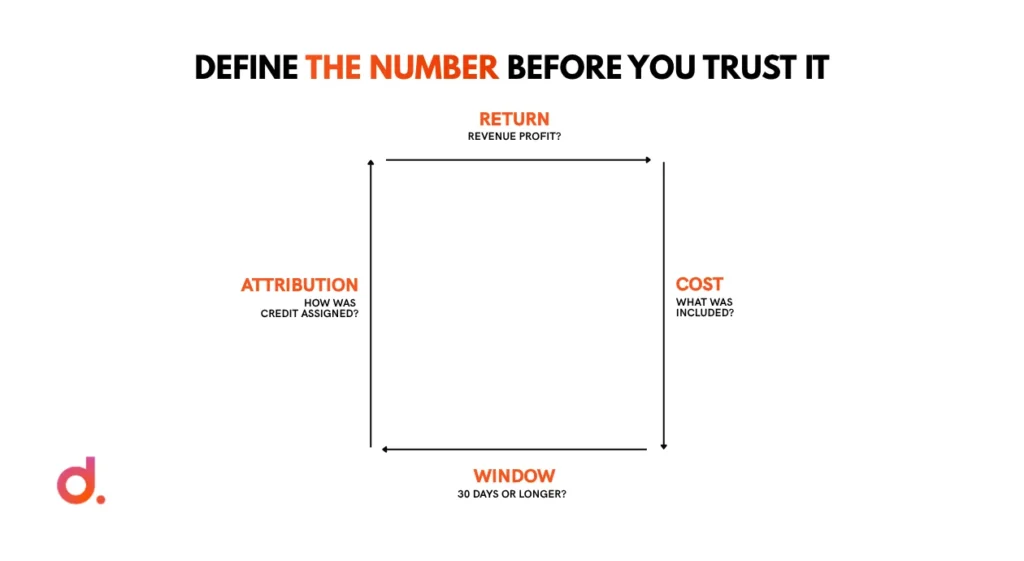
A believable marketing ROI number has a clear definition, a stated time period, real cost inputs, and a known attribution method.
At minimum, document:
- What counts as marketing return.
- What counts as marketing cost.
- Whether the return is revenue or profit-based.
- Which attribution model is used.
- Whether repeat purchases are included.
- Whether refunds/returns are deducted.
- The measurement window.
- Any major known blind spots.
Example:
“For Q2, paid acquisition produced $180,000 in first-order net revenue against $60,000 in media, creative, and agency cost. This is a revenue-based marketing ROI calculation using GA4 data-driven attribution and excludes later repeat revenue. CRM offline sales are not included.”
That statement is less dramatic than “200% ROI.”
It is far more useful.
Long-term effects also matter. Marketing that builds demand can continue producing returns after the reporting window ends. A Google/WARC report on long-term measurement argues that short-term reporting can materially understate sustained media returns. You do not need to accept every benchmark in the report to accept the broader point: a 30-day dashboard can miss value created over a much longer buying cycle.
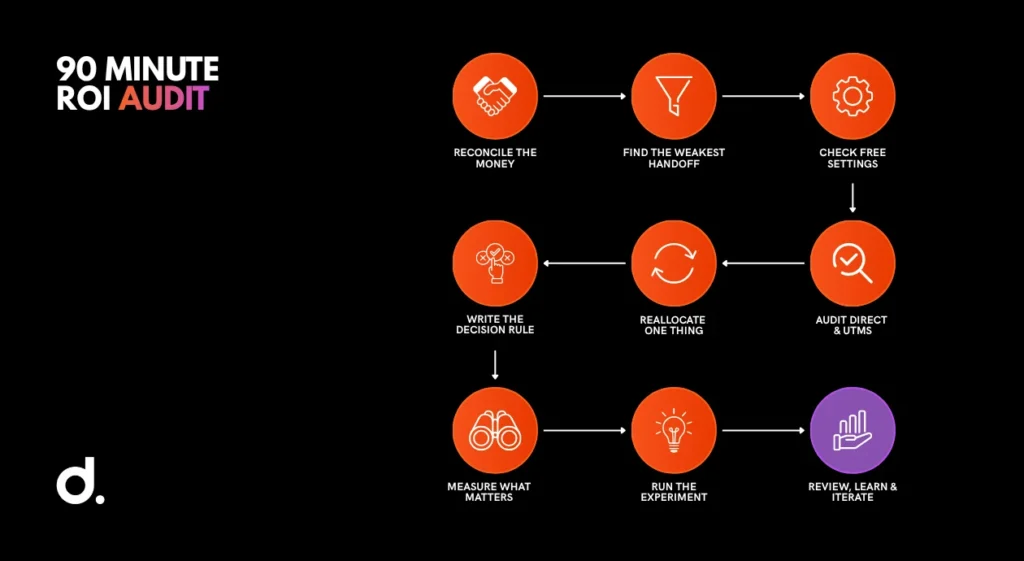
A 90-Minute No-New-Spend ROI Audit
If you want a practical starting point, block 90 minutes and do this in order.
First 20 Minutes: Reconcile the Money
Write down:
- Total marketing spend.
- Actual revenue.
- New-customer revenue.
- Gross/contribution margin if available.
- Platform-attributed revenue by channel.
If platform totals exceed real revenue, label the overclaim rather than forcing the numbers to reconcile.
Next 20 Minutes: Find the Weakest Handoff
Pick one journey.
Ad → landing page → lead → qualified lead → sale.
Or:
Product view → cart → checkout → purchase.
Calculate conversion between each stage.
Next 20 Minutes: Check Free Settings
Review conversion actions, audience expansion, location settings, email segmentation, UTMs, direct traffic, and broken links.
Next 20 Minutes: Reallocate One Thing
Do not move half the budget.
Move one clearly weak allocation toward one clearly stronger opportunity and define what you expect to change.
Final 10 Minutes: Write the Decision Rule
For example:
“We will shift $2,000 from Campaign A to Campaign B for four weeks. We will judge the change by qualified-pipeline value and total CAC, not platform ROAS alone.”
Now you have an experiment rather than an opinion.
Frequently Asked Questions
What is marketing ROI?
Marketing ROI compares the financial return associated with marketing against the cost of creating that return. A common formula is (return − marketing cost) ÷ marketing cost × 100. The calculation becomes more meaningful when the business clearly defines whether “return” means revenue, gross profit, contribution margin, or incremental profit.
How can I improve marketing ROI without increasing my budget?
Start by reallocating existing spend, correcting conversion and targeting settings, improving high-friction landing pages, segmenting email better, and fixing tracking gaps. These changes use the budget you already have. The goal is to reduce waste and improve the amount of real revenue or profit produced per dollar already committed.
What is the difference between ROI and ROAS?
ROAS compares attributed advertising revenue with ad spend. ROI is broader and should account for the cost required to generate the return. A campaign can have strong ROAS but weak ROI after creative, agency, software, product cost, discounts, returns, and other expenses are included.
Why is my marketing ROI low even when ROAS looks good?
The platform may be over-attributing sales, the campaign may rely on heavy discounting, customer acquisition cost may be too high, or the business may have weak margins and high returns. Check real revenue, contribution margin, repeat purchase, and total marketing cost rather than relying on the ad platform’s ROAS alone.
What should I optimize first to improve ROI?
Start with the largest commercial leak you can verify. That could be poor lead quality, a weak checkout step, a broken conversion action, wasted audience spend, or missing follow-up. Do not begin with the easiest cosmetic change. Begin where the evidence shows money is being lost.
Stop Treating Budget as the Only Lever
When marketing underperforms, the default response is often to add something.
Another channel. Another campaign. Another tool. Another landing page. Another agency.
Sometimes you do need more investment.
But first ask whether the money already in the system is doing the job it was hired to do.
Can you prove where revenue came from? Are platforms optimizing the right conversions? Are qualified leads making it to sales? Is checkout working? Are existing customers receiving relevant email? Is direct traffic hiding lost attribution? Is a weak channel actually weak, or is the page after the click failing?
That is the diagnosis.
The budget decision comes after.
Digital Shaping’s broader growth services are built around that order: find the one or two things actually costing revenue, then fix those before adding more noise.
Sometimes the fastest way to improve marketing ROI is to spend more.
Sometimes it is to stop wasting what you already spend.